
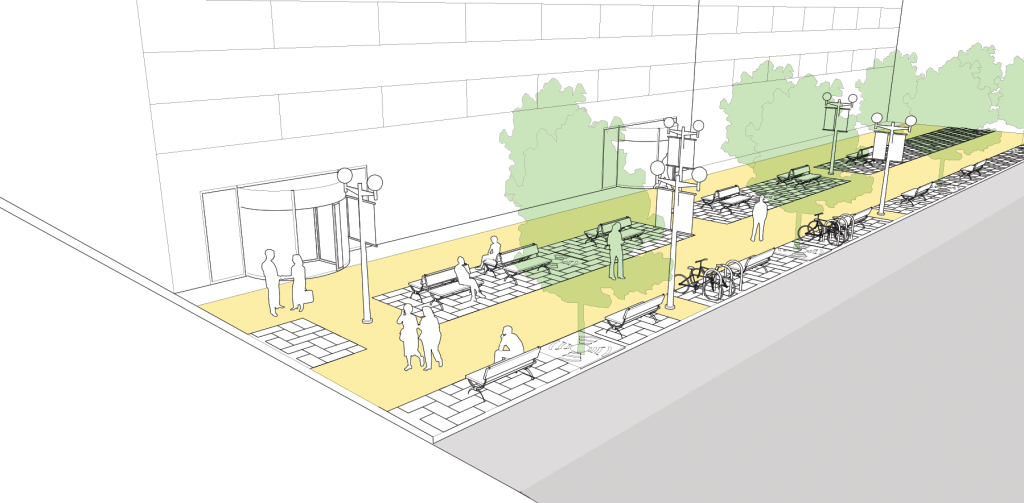
A city’s approach to sidewalks has a huge impact on the experiences of its pedestrians. The Federation of Canadian Municipalities and the National Research Council published Sidewalk Design, Construction and Maintenance, which “recommends a minimum Residential Street sidewalk width of 1.5 metres. When the sidewalk is located adjacent to the curb on major roadways, the width should be increased to 1.8 metres. The preferred width to provide for the safe passage between an adult and a person pushing a baby carriage or in a wheelchair, or a child on a tricycle is 1.8 metres.” Of course, there are often bits of infrastructure that take up space on sidewalks – signs, street lights, utility boxes, parking meters (!), bus stops, trees – so even the minimum width is often not sufficient for two people to walk alongside or pass one another, which is why the City of Toronto mandates that new sidewalks be at least 2.1 meters wide.
Cities also have to deal with design decisions of previous eras. The sidewalks in my neighbourhood in Regina, which was developed in the early 1900s, are about the width of the current minimum, but some North American neighbourhoods built in the 1960s and 1970s don’t have any sidewalks at all or only on one side of the street, and often those aren’t as wide as our current minimum.
Sidewalk width is only one aspect of what a municipality can do to enhance its walkability. The U.S. based National Association of City Transportation Officials (NACTO) offers some recommendations, “sidewalk design should go beyond the bare minimums in both width and amenities. Pedestrians and businesses thrive where sidewalks have been designed at an appropriate scale, with sufficient lighting, shade, and street level activity. These considerations are especially important for streets with higher traffic speeds and volumes, where pedestrians may otherwise feel unsafe and avoid walking“. We’ll look at other aspects of what makes a good sidewalk in future posts.
 Project Pedestrian
Leave a comment