
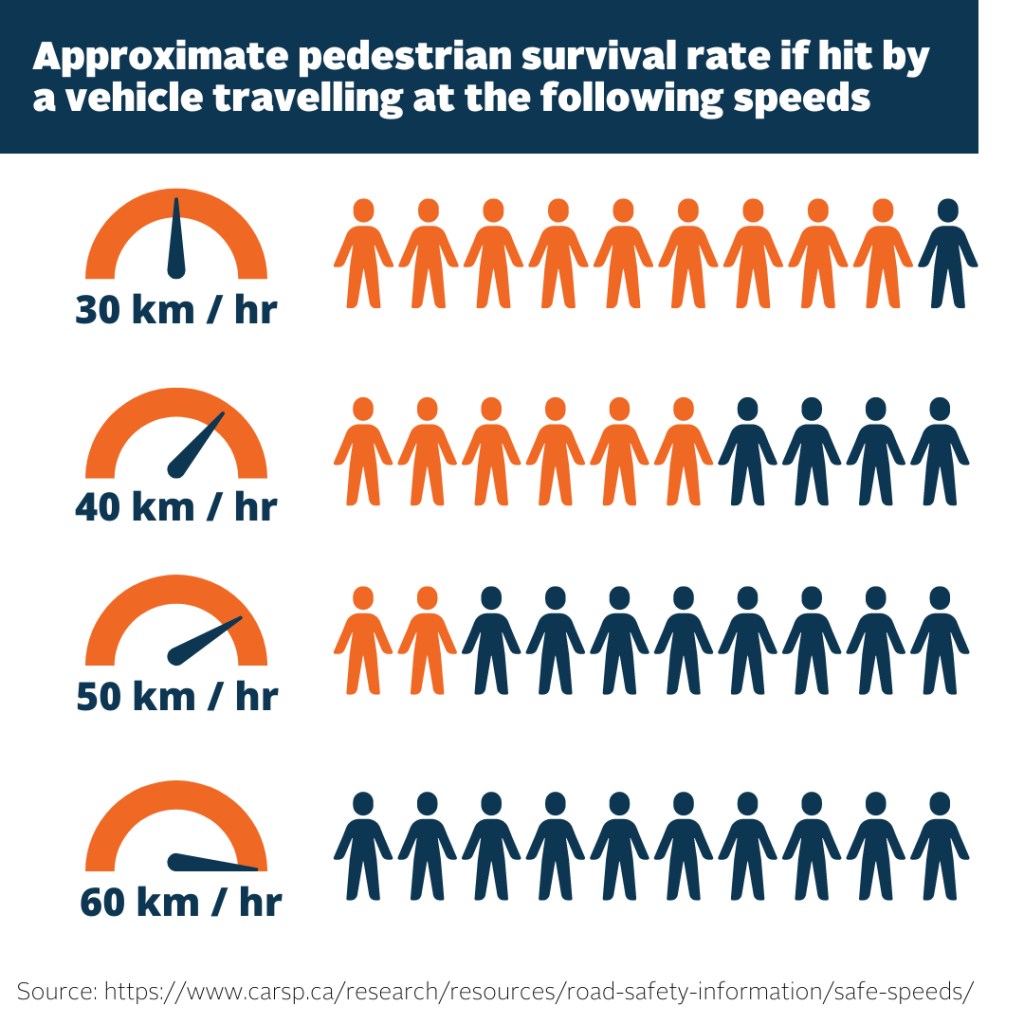
A significant factor contributing to pedestrian deaths and serious injuries is the speed a vehicle is going when it hits them. A pedestrian hit by a vehicle moving at 30 km/h has a 9 in 10 chance of surviving the collision; a pedestrian hit by a vehicle moving at 50 km/h has a 2 in 10 chance of surviving. (For those in the U.K./U.S., 30km/h = 18 mp/h, 50 km/h = 31 mp/h)
In my neighbourhood in Regina, Saskatchewan, two pedestrians were killed by vehicles in the span of a few months. In response, the City changed the neighbourhood’s speed limit to 40 km/h. In the rest of the city, limits are usually 50 km/h and on some roads 70 and 80 km/h.
The City of Regina reduced speed limits around schools and playgrounds to 30 km/h in 2019. As a driver, it was an adjustment to go down to 30 km/h, but it was evident how much more control I had over a car moving at 30 km/h compared to going 50 km/h; there’s more time to react to things and I can stop the car quicker. When I’m driving 30 km/h I’m still moving faster than most humans have ever moved until well into the 20th century and I’ll still get to my destination quicker than if I were walking or on a bike.
Because of congestion (i.e. too many vehicles on the road) many North American cities actually have average driving speeds that are under 20 km/h, so there’s really no need to allow vehicles to “open up” to faster speeds. Getting to a red light quicker doesn’t get you to your destination any sooner.
As a motorist, I’ve started to think that all roads with pedestrians crossing or walking alongside should have the maximum speed limit of 30 km/h, as this paper, and this paper, and this paper, and this paper argue. Some cities, like Paris, Brussels, Madrid and Amsterdam have already made this shift, as have 60 municipalities in British Columbia.
Keeping motorized vehicles at 30 km/h in urban environments saves lives, and probably also helps to calm us all down. It’s time we turned away from allowing motorized vehicles to dominate our cities and our lives.


Leave a Reply