
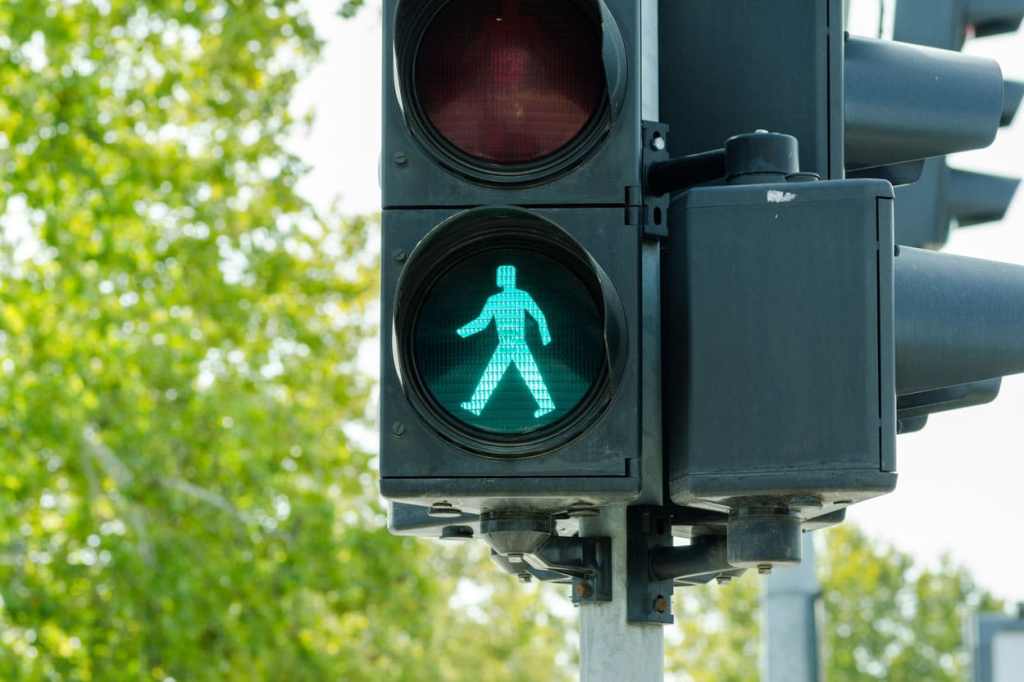
A news story on the length of time a pedestrian light was green, alerted me to an issue about infrastructure I hadn’t yet thought about – how do cities calculate the time needed for an “average” pedestrian to cross an intersection?
A few years ago, the City of Saskatoon shifted to calculating an average walking speed of 1 meter per second, but not all their traffic signals have been updated to this standard and some are still based on the expectation of someone walking 1.2 meters per second. 1 meter a second is the equivalent of 3.6 km/h and 1.2 meters per second is the equivalent of 4.32 km/h.
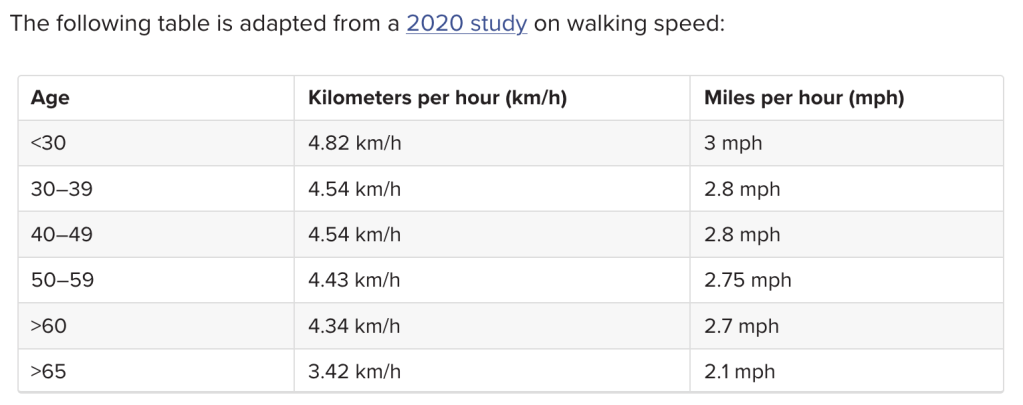
A Medical News Today chart (see below), drawing on research from Portuguese academics, shows average walking speeds range from 4.82 km/h for people under 30 to 3.42 km/h for people over 65. This suggests cities using 1 meter per second to calculate their pedestrian lights are not serving the portion of the population over 65, and people of all ages who for a range of reasons may not able to move at 1 meter a second.
The City of Toronto has a 34-page document outlining Pedestrian Timing at Signalised Intersections, which includes passages like: The modified methodology provides for two walk speeds, vfdw related to the FDW duration and vtot related to the combined WALK plus FDW durations. The pedestrian crossing time, Tped (in seconds) is calculated using Equation 1:
Tped = tw + tfdw (Equation 1)
If twmin + dw / vfdw > dw / vtot, then tfdw = dw / vfdw
If twmin + dw / vfdw < dw / vtot, then tfdw = ( dw / vtot ) – twmin
Have you ever felt rushed to get across an intersection in the allotted time?
I know I have.
 Project Pedestrian
Leave a comment